If you’ve landed here, you’re probably interested in a mold inspection. You may be exploring different types of inspections and want to know how accurate a mold dog actually is at finding mold. Or, you’ve never heard of mold dogs and are curious about them.
In any case, you’ve come to the right place. Below, we’ll cover all things mold dogs and answer the most common questions we get asked about them.
What is a mold detection dog?
Mold detection dogs are trained to identify the scent of mold in homes and buildings. They work alongside certified handlers, moving through a space and alerting when they detect mold odor. Not all mold dogs are trained to the same standard, so if you’re considering working with one, we recommend asking about their training and choosing a dog that has been thoroughly trained by a reputable, experienced trainer.
The mold detection dog practice grew out of the broader field of scent detection work, which you may be more familiar with, including dogs trained to find drugs, explosives, and even certain cancers.
How do mold detection dogs work?
Dogs have up to 300 million olfactory receptors in their noses. For context, humans have about 6 million. That gives dogs a sense of smell estimated to be up to 100,000 times more sensitive than ours.
“Unlike humans, dogs have an additional olfactory tool that increases their ability to smell.” (source)
Mold detection dogs are trained to identify the volatile organic compounds (VOCs) that mold releases as it grows. These compounds have a distinct scent profile. Dogs learn to recognize it through repetition and reward-based training.
During an inspection, the handler systematically guides the dog through a space. When the dog detects mold odor, it gives a trained alert, which might be sitting (this is our dog’s cue), pawing, or freezing near the source.
The whole process is a team effort, requiring the handler to read the dog’s body language closely and know when the dog is working versus when it’s distracted. (Dogs are animals, after all! And besides mold, they regularly detect all kinds of odors that may interest them. This is why it’s so important to find a certified dog and handler that work together regularly and can stay focused to detect hidden mold.)
See more photos and videos of our mold dog at work on our Instagram, @fidofindsmold.
Can dogs detect mold in walls?
Yes, and this is where mold detection dogs really stand out.
There are lots of different mold inspection and testing methods out there, but they’re not all created equal. Visual inspections only catch what you can see. Moisture meters can flag damp areas, but moisture alone doesn’t confirm mold. Air sampling may capture spores floating in the air, but can be thrown off by humidity levels and outdoor air infiltrating indoor space.
Dogs don’t have these limitations. A mold dog alerts where the scent of mold is strongest. They can detect the sources of mold odor seeping through drywall, flooring, insulation, and other materials, which standard inspections can miss entirely.
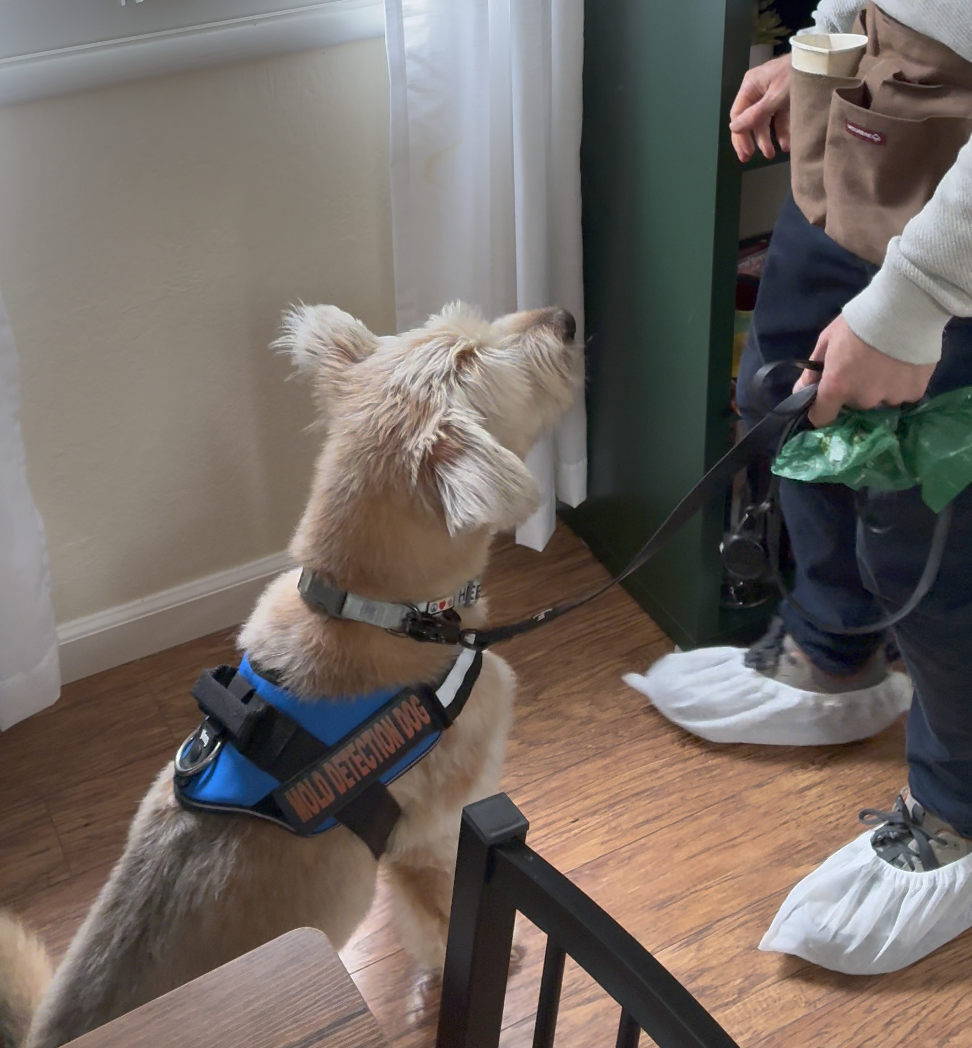
They can also cover a large area efficiently. For reference, our mold dog inspections are typically 2-3 hours, which also includes a thorough interior and exterior visual inspection. Of course, this varies depending on the size and complexity of the space being inspected.
That said, dogs identify the presence and location of mold. They don't tell you what species it is or how severe the problem is. Lab testing is still needed to get that information.
Are mold detection dogs accurate?
As we’ve already covered, mold dogs can detect mold with impressive precision, with noses around 100,000 times more sensitive than a human’s. A few factors affect accuracy:
Handler experience: The dog and handler work as a unit. A skilled handler should regularly work and spend time bonding with the dog, as well as know how to run a search pattern, read the dog’s alerts, and avoid cueing the dog accidentally.
Training and certification: Look for teams certified through recognized programs. Our mold dog Hee-do and Simon, his handler, were both certified by master trainer Bill Whistine, who’s widely considered the leading authority on mold dog training.
Proven reliability in high-stakes environments: Detection dogs are trusted in national security settings to locate explosives, narcotics, and other hidden threats, so when properly trained and handled, their noses are more than capable of accurately identifying hidden mold in your home.
When should you hire a mold detection dog?
A mold dog inspection makes the most sense in a few situations:
You smell mold but can’t find it: We often hear from folks who smell a musty odor that lingers, which is one of the strongest signs of hidden mold. If you’ve looked and found nothing, a dog can help narrow it down.
Your home recently had water damage: Flooding, leaks, and burst pipes create the conditions mold needs to grow. A dog inspection after water damage can catch mold before it spreads.
Someone in the household is symptomatic: Mold can have a profound impact on your health. This has been the case for us and for many of our clients. We often hear from people who are experiencing health issues and want to make sure their home or workplace are not the reason for their symptoms.
After a traditional inspection: If an inspector flagged concerns but couldn’t pinpoint the source, or if they didn’t find anything but you believe you’re dealing with mold, a mold dog can help find problematic areas.
You’re buying or selling a home: Some buyers are now requesting mold dog inspections as part of the due diligence process, especially in older homes.
We also recommend asking mold dog teams for certification credentials and proof that the dog undergoes regular proficiency testing. The handler should be willing to walk you through how the inspection works before you hire them.
Mold detection dogs are a legitimate tool for finding hidden mold. Their noses can do what no meter or camera can: detect mold behind walls, under floors, and inside spaces that are otherwise impossible to inspect. Cool, right?
If you suspect mold in your home and haven’t been able to locate it, a certified mold detection dog team is worth a call.
Get in touch
If you’re in the San Francisco Bay Area and want to learn more about our approach to mold dog inspections, give us a call or text: (510) 822-0277.